
Vegastars Payments Australia: Deposits, PayID, Cards and Crypto
 Available in AU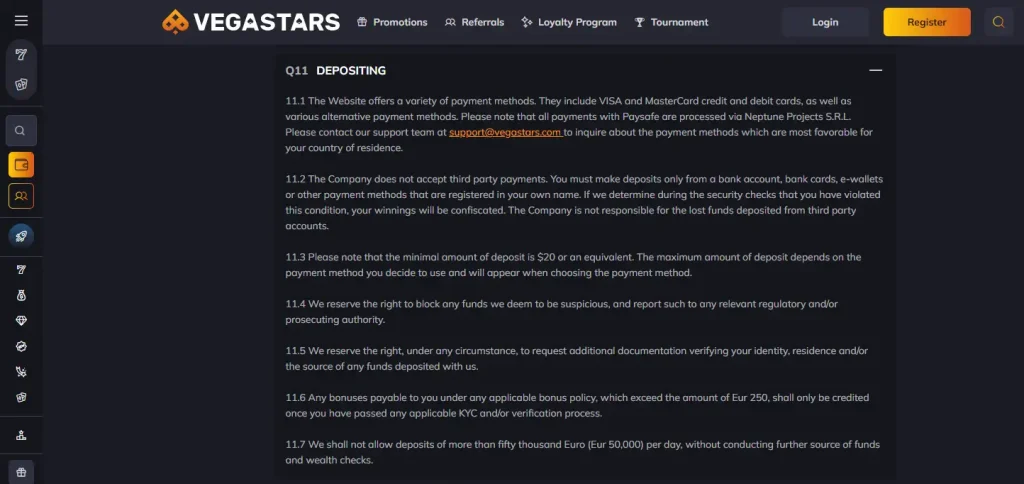
Payments guide – Australia
Vegastars’ AU-facing payment information includes Visa/Mastercard, PayID, e-wallet and crypto options, while the general terms state a minimum deposit of $20 or equivalent. The exact methods shown can still depend on the account and payment provider, so the cashier remains the final source for what you can use at that moment. For Australians, PayID is especially relevant because it is already a mainstream account-to-account payment method rather than a niche banking tool.
Table of Contents
- Vegastars payment methods shown on the AU-facing site
- The general minimum deposit is or equivalent
- Why PayID matters more in Australia than a generic banking list suggests
- Cards remain the dominant consumer payment method in Australia
- E-wallets and crypto need an extra layer of detail
- Deposit choice and withdrawal choice are related but not identical
- How to compare payment methods without assuming one is universally best
- Payment-method visibility is a live account detail
- Keep bonus qualification separate from ordinary depositing
- A practical deposit check for an Australian account
- What this payment page does not promise
- How Vegastars payments line up with Australian banking habits
Vegastars payment methods shown on the AU-facing site
The current AU-facing payment information lists four broad routes: cards, PayID, e-wallets and cryptocurrency. It specifically names Visa and Mastercard within the card category. That is enough to describe the payment mix without pretending every processor or wallet is available to every Australian account.
| Payment route | Current public information | What to confirm in the cashier |
|---|---|---|
| Visa / Mastercard | Cards are included in the published payment mix | Whether your card type is currently offered and any displayed limits |
| PayID | Listed on the AU-facing site | The current PayID instructions and account-specific availability |
| E-wallets | E-wallet options are part of the published mix | Which named wallet providers appear for your account |
| Crypto | Crypto options are published for the AU-facing site | Supported assets, network details and the exact deposit instruction |
This page does not turn those categories into a permanent processor list. Payment menus can change, and a category being supported does not guarantee that every individual service inside that category is visible to every user.
The general minimum deposit is $20 or equivalent
Vegastars’ current general terms state that the minimum deposit is $20 or an equivalent amount. The same terms say that the maximum depends on the payment method and is shown when that method is selected. That makes the cashier important even when the headline minimum is known.
Do not confuse the general deposit minimum with an offer-specific qualifying deposit. A bonus can have its own requirements. If the deposit is being made to trigger a promotion, read the relevant bonus conditions rather than assuming the general $20 threshold is the only number that matters.
The terms also require deposits to come from payment methods in the player’s own name. That is a useful practical reason to avoid third-party cards or accounts, even before any later verification step is considered.
Why PayID matters more in Australia than a generic banking list suggests
The Reserve Bank of Australia’s 2025 Consumer Payments Survey shows why PayID deserves attention on an Australian payments page. Around 80% of respondents were aware of PayID, and around 50% said they had used it in the previous year. The RBA describes PayID as a way to make payments using an identifier such as a mobile number, email address or ABN rather than manually entering bank account details.
That does not make PayID automatically preferable for a casino deposit. It explains why its presence is locally meaningful: many Australians already understand the payment rail and use it outside gambling. The decision still comes down to what the Vegastars cashier shows, whether the payment is appropriate for your circumstances and whether your bank permits the transaction.
Cards remain the dominant consumer payment method in Australia
The same RBA survey found cards accounted for about 73% of consumer payments in 2025, with debit cards alone accounting for about half. That broad market context helps explain why card support is still relevant even as account-to-account payments grow.
For a Vegastars deposit, however, everyday card popularity does not prove that a particular Australian card will be accepted. Issuer rules, account settings and the payment processor can affect what is available. The current cashier should therefore outrank any static payment-method list.
It is also worth separating payment familiarity from borrowing. A familiar credit-card logo does not mean using borrowed funds for gambling is a sound choice. A pre-set gambling budget should come before the payment method.
E-wallets and crypto need an extra layer of detail
The current AU-facing payment information includes e-wallet and crypto options, but it does not provide a permanent list of every wallet, coin, network or fee. Those specifics should be read from the live cashier because they can change faster than the broad category.
With an e-wallet, check that the wallet account is in your own name and confirm any displayed limits before depositing. With crypto, verify the asset and network exactly. Sending an asset over the wrong network can be materially different from choosing the wrong card option, so copying the current cashier instruction matters.
This page also avoids converting crypto amounts into AUD unless the source itself provides the conversion. Exchange values move, so this guide does not publish an AUD conversion unless a current primary source supports it.
Deposit choice and withdrawal choice are related but not identical
A method that works for depositing does not automatically have the same payout rules. Withdrawal eligibility, limits, processing and verification belong to a separate decision. For that reason, this page does not publish exact payout speeds or withdrawal fees.
Use the dedicated Vegastars withdrawals guide for payout-specific checks. That separation prevents deposit marketing from being mistaken for a guarantee about cashing out. It also keeps KYC-specific document questions on the KYC verification page, where those higher-risk details can be checked against the relevant policy.
How to compare payment methods without assuming one is universally best
A practical comparison starts with four questions: is the method visible in the current cashier, is it in your own name, are the displayed limits suitable for the amount you intend to deposit, and do you understand how the transaction appears in your banking or wallet app? Those questions are more useful than a generic ranking because the answer can differ by account and provider.
Cards are familiar to most Australians, PayID is increasingly common for account-to-account payments, e-wallets can separate the casino transaction from a primary card, and crypto has a different operational risk profile because the asset and network must match the instruction exactly. None of those characteristics makes one route automatically preferable. The sensible choice is the method you understand, can verify in the live cashier and can use without exceeding a pre-set gambling budget.
| Decision point | Why it matters | What to verify |
|---|---|---|
| Current visibility | Methods can vary by account/provider | The option is present in the live cashier |
| Ownership | The terms require own-name payment sources | The card, bank account or wallet belongs to you |
| Limits | Maximums can differ by method | The cashier’s displayed min/max for that route |
| Instructions | PayID and crypto rely on exact transaction details | Recipient, asset, network or reference matches the current instruction |
Payment-method visibility is a live account detail
Static review pages can confirm broad supported categories, but the logged-in cashier is the operational source for what is offered to a specific account. This matters when a bank, processor or wallet changes its availability. It also matters when two users see different sets of methods because of account or provider rules.
For that reason, this guide treats the verified payment mix as a starting map rather than a promise. If a listed category does not appear, do not assume a technical fault and do not use payment details copied from elsewhere. The safer interpretation is that the current cashier controls the transaction path.
Keep bonus qualification separate from ordinary depositing
The general $20-or-equivalent minimum deposit is a baseline term, not a universal bonus trigger. Promotions can attach their own minimum deposit, opt-in step or other conditions. If the purpose of a deposit is to qualify for an offer, check the specific promotion before sending money and compare that requirement with the cashier amount.
This distinction prevents a common mistake: treating “minimum deposit” and “minimum qualifying deposit” as interchangeable. They answer different questions. One governs the general account funding threshold, while the other may belong to a particular offer.
A practical deposit check for an Australian account
- Open the current cashier from your own logged-in account.
- Compare the methods actually shown there with the categories above.
- Check the displayed minimum and maximum for the method you select.
- Use a payment source in your own name.
- If a bonus is involved, read the offer-specific terms before depositing.
- Keep the payment receipt or transaction reference until the balance is correctly credited.
If registration details are still incomplete, the registration and account guide explains the account flow. The Australia FAQ collects broader questions that do not need a full standalone page.
What this payment page does not promise
It does not promise that PayID, a particular card, a named e-wallet or a crypto asset will appear for every account. It does not publish unsupported deposit or withdrawal fees. And it does not treat an AU-facing cashier as evidence of an Australian gambling licence.
Those boundaries matter because payment availability is operational, while licensing is regulatory. Mixing the two creates misleading conclusions. For the broader brand context, see the Vegastars Australia review. The payment claim here is narrower: Vegastars publishes cards, PayID, e-wallet and crypto options for its AU-facing service, subject to what the current account/provider flow actually displays.
How Vegastars payments line up with Australian banking habits
The payment mix overlaps with two well-established Australian behaviours: heavy card use and growing PayID adoption. That makes the cashier feel locally recognisable without requiring a long list of obscure processors. The strongest practical signal is not the number of logos but whether the account currently shows a method you already understand and can use within a fixed gambling budget.
For deposits, start with the current cashier and its displayed limits. For payouts, move to the dedicated payout guide rather than assuming the same conditions apply in reverse. That division keeps the two decisions clear and avoids unsupported promises about speed or fees.