
Vegastars KYC: Verification Documents and Withdrawal Checks
 Available in AU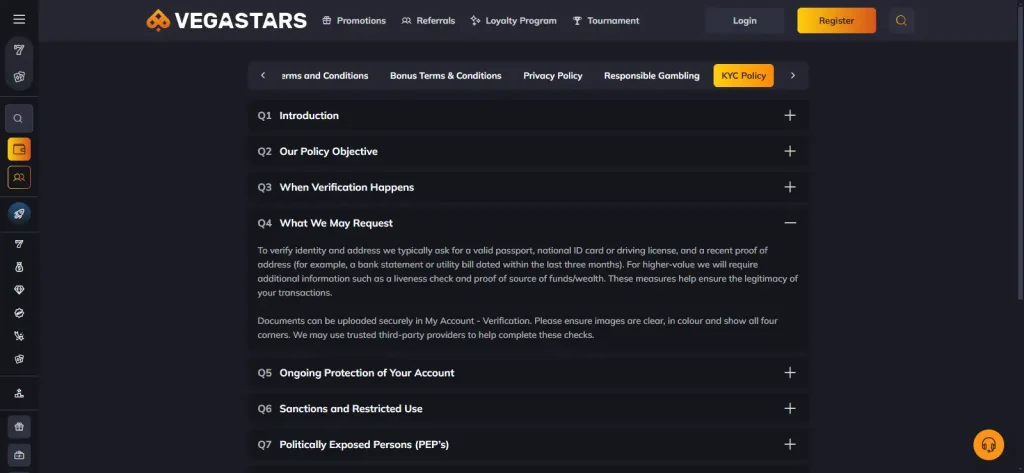
KYC guide – Australia
Vegastars’ current KYC policy says the operator may request identity and location evidence and can restrict service, payments or withdrawals until identity is sufficiently determined. The official document categories include government-issued photo ID, proof of address and payment information relevant to the method used. Additional verification can also be requested. The exact request is account-specific, so this page does not invent a fixed checklist or completion time. For withdrawals, the important point is that Vegastars can verify identity before processing a payout and can hold the withdrawal while that review is carried out.
Table of Contents
- Vegastars KYC document categories in the official policy
- Why KYC can become a withdrawal gate
- Common document problems the policy itself identifies
- Identity, address and payment evidence serve different purposes
- Additional verification is possible when standard evidence is not enough
- What not to assume about a completed KYC review
- A practical way to prepare documents without over-sharing
- When Vegastars may ask for more evidence
- Match each document to the category actually requested
- How Vegastars verification affects an Australian cashout
Vegastars KYC document categories in the official policy
The operator’s KYC policy gives a clearer source than generic casino checklists because it names the types of evidence Vegastars may request. The categories below reflect the current policy rather than a universal promise that every account will be asked for every item.
| Category | Examples in the policy | What it verifies |
|---|---|---|
| Photo identification | Passport, driver’s licence or national ID card | Identity and age-related account details |
| Proof of address | Recent utility bill, bank statement or official correspondence | Residential address |
| Payment information | Bank, card, e-wallet or relevant voucher/crypto account information | Relationship between the account holder and payment method |
| Additional checks | Further ID, a photo with ID, or biometric face verification | Extra assurance when standard evidence is not sufficient |
This is a category-level summary. The policy allows Vegastars to ask for additional documentation when the initial evidence is not sufficient, so a player should not assume that one fixed bundle applies to every case. Conversely, it would be inaccurate to claim that every listed item is mandatory for every account.
Why KYC can become a withdrawal gate
Vegastars’ current terms reserve the right to check identity before processing payouts and to hold a refund or withdrawal for the time needed to perform that check. The KYC policy similarly states that service, payment or withdrawal can be restricted until identity is sufficiently determined. Together, those provisions explain why verification can surface at cashout even if an account has already been used.
The practical sequence is therefore not “withdrawal requested, money automatically sent”. A request can first enter an account-review stage. If the operator asks for documents, the review has to be resolved before the payout process can proceed normally. For method and timing detail beyond verification, see the Vegastars withdrawals.
No fixed KYC completion time is stated here. The official policies describe the operator’s right to review identity and request further evidence, but they do not support one universal turnaround promise for every account.
Common document problems the policy itself identifies
The KYC policy also lists reasons documents may not be approved. These are useful because they are concrete submission-quality issues rather than speculation about the operator’s internal review queue.
- The name or address on a document does not match the account details.
- The image or copy is illegible.
- The document is damaged.
- Not all four corners of the document are visible.
- The document does not confirm the required account information.
- The submitted image is black and white where the review requires a clearer usable copy.
Avoiding those issues does not guarantee approval, but it removes preventable mismatches. The operator can still ask for additional evidence if it considers the original material insufficient.
Identity, address and payment evidence serve different purposes
It helps to treat the categories as separate checks. Photo ID ties the account to a person. Proof of address supports the residential details on the account. Payment evidence connects financial activity to a method associated with the account holder. A request for more than one category is therefore not necessarily duplicate paperwork; the documents answer different verification questions.
This also explains why accurate registration data matters. If the name or address entered when the account was created differs from later evidence, the KYC policy explicitly identifies that mismatch as a potential reason for non-approval. The registration and account explains where verification sits in the full account lifecycle.
For payment evidence, users should follow the exact request shown for their account rather than uploading unrelated financial documents. The policy lists broad categories, while the specific evidence needed can depend on the payment method and the reason for the review.
Additional verification is possible when standard evidence is not enough
The official policy says Vegastars may ask for additional documentation if the first set is not sufficient. Examples listed in the policy include an additional government-issued ID, a photo of the user with the identification document, and biometric face verification. These are not presented here as routine requirements for every player; they are possible extra checks.
The distinction matters because a generic “Vegastars KYC documents” search can produce overbroad lists that make exceptional checks sound mandatory. The source-backed reading is narrower: photo ID, proof of address and applicable payment information are core categories, while further checks may be requested depending on the account review.
What not to assume about a completed KYC review
Passing identity checks should not be treated as a guarantee of a particular payout time, payment method or withdrawal outcome. KYC is one dependency in the cashout process. The withdrawal method can have its own limits and processing mechanics, and promotion-specific terms can create separate conditions where relevant.
KYC also answers an account-verification question, not every broader question about the service. For the separate Australian context, use the trust and regulation guide. This page stays limited to the official document categories, the possibility of additional checks and the way verification can affect a withdrawal review.
A practical way to prepare documents without over-sharing
The best preparation is to respond to the actual request rather than sending every document you possess. Use clear, current images, make sure the account details match the evidence, and include the full document framing when the policy requires it. If payment evidence is requested, use the category connected to the method involved in the account activity.
Do not assume that supplying more unrelated documents will make a review faster. The operator’s policy is account-specific and allows additional checks where needed. A focused response to the requested categories reduces avoidable confusion while keeping unnecessary personal information out of the submission.
If the question is broader than verification, the Australia FAQ collects common account, payment and access topics in one place.
When Vegastars may ask for more evidence
The policy uses a risk-based approach rather than one fixed document bundle for every customer. A standard request can therefore expand if the original material does not sufficiently establish identity, address or the payment relationship. That is why the most efficient response is to follow the exact request shown for the account, rather than assuming that another player’s checklist will match your own.
Because the policy also allows ongoing monitoring, verification should be viewed as an account-control process that can recur when circumstances change or additional assurance is required.
Match each document to the category actually requested
The official policy separates identity evidence, proof of address and payment-related evidence because they answer different verification questions. A government-issued photo ID is used to establish identity, proof of address supports location or residence information, and payment evidence can connect a funding method to the account. Treating those categories as interchangeable can create avoidable back-and-forth if the operator has asked for one specific type of evidence.
Before submitting anything, read the exact request in the account or support message and provide only what is needed for that category. Check that the document is legible and that the relevant details match the account information. If the operator asks for additional verification, respond to that request rather than assuming that a previously accepted document automatically covers the new check. The policy allows additional checks, so a completed first step should not be described as a guarantee that no further evidence will ever be needed.
This matters most around withdrawals because verification can pause the payout process. Keeping the requested evidence organised does not create a fixed completion time, but it can reduce delays caused by mismatched or incomplete submissions. For the payout sequence itself, use the Vegastars withdrawals guide.
How Vegastars verification affects an Australian cashout
For an Australian user, KYC matters most at the point where account identity and a withdrawal intersect. Vegastars can review identity before processing a payout and can hold the withdrawal while that review is underway. The current policy supports photo ID, proof of address and relevant payment information as core evidence categories, with additional verification possible when the initial material is not enough.
The safest expectation is therefore procedural rather than time-based: keep account details consistent, submit the specific evidence requested, make the documents legible and complete, and do not rely on a fixed verification deadline that the source does not provide. That is the clearest evidence-backed way to understand how Vegastars KYC can affect a cashout.
For a related overview, see Vegastars Australia review.
Recommend

Vegastars Bonus Australia: Welcome Offer and Key Terms
Vegastars Australia Guide Bonus guide - AustraliaThe current AU welcome-bonus page shows the three-deposit structure...

Vegastars Payments Australia: Deposits, PayID, Cards and Crypto
Vegastars Australia Guide Payments guide - AustraliaThe current payment view shows the deposit and payment...

Vegastars Games Australia: Pokies, Tables and Providers
Vegastars Australia Guide Games guide - AustraliaThe current AU casino lobby shows category and provider...
Vegastars Trust and Regulation in Australia: ACMA, Licence and Player Protections
Vegastars Australia Guide Trust and regulation - AustraliaThe ACMA publication records the Vegastars enforcement and...

Vegastars Mobile Australia: Browser Access, iPhone and Android
Vegastars Australia Guide Mobile guide - AustraliaThe AU-facing site at phone width shows the browser-based...

Vegastars Registration Australia: Account Setup, Login and Verification
Vegastars Australia Guide Account guide - AustraliaThe current AU-facing account interface shows the registration and...
Vegastars Australia FAQ: Payments, Tax, BetStop and Common Questions
Vegastars Australia Guide FAQ - AustraliaThe FAQ groups the main account, payment, mobile, verification and...